
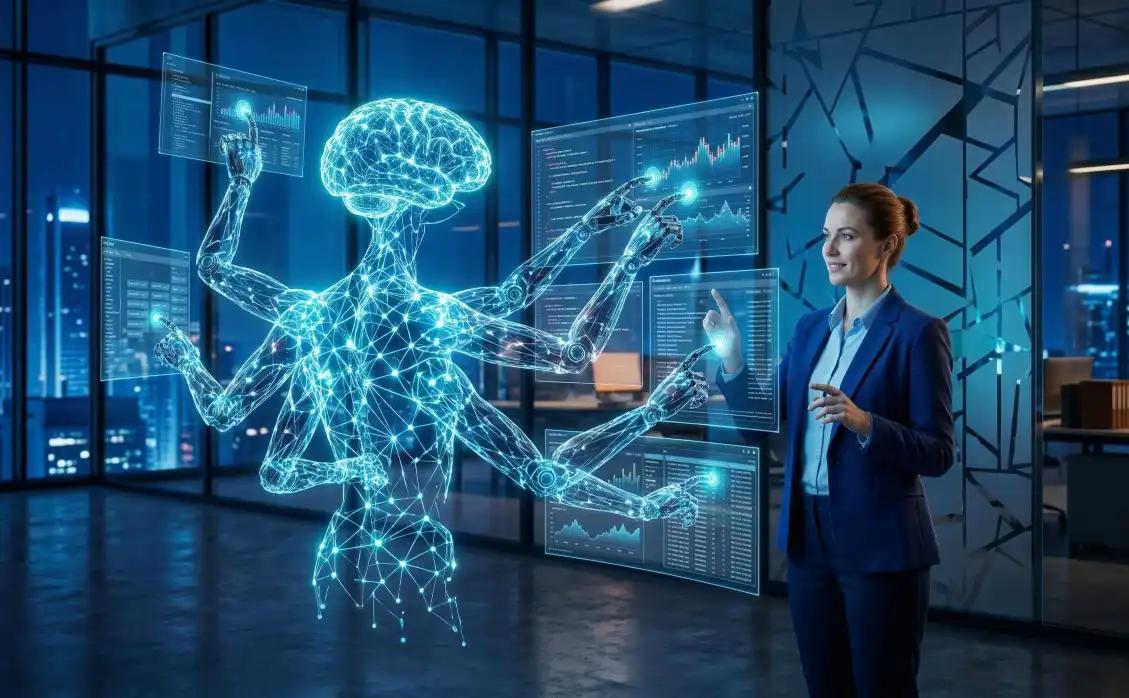
The Paradigm Shift: From Passive Tools to Active Teammates
The artificial intelligence landscape in March 2026 has crossed a critical threshold. For the past three years, the world was captivated by generative AI in the form of chatbots—systems that required constant human prompting, supervision, and correction. They were incredibly powerful tools, but they were fundamentally passive. Today, that era is ending. Industry leaders, including prominent executives at Microsoft and emerging tech vanguard companies, have declared 2026 as the definitive year of "Agentic AI." This is no longer about a machine generating text based on a human request; it is about intelligent systems capable of making decisions, carrying out multi-step tasks independently, and acting as autonomous digital collaborators. The shift from "tool" to "teammate" is the most profound technological breakthrough of the decade, and it is reshaping the architecture of digital productivity from the ground up.
To understand the magnitude of this shift, one must look at how businesses are deploying these new systems. According to the latest database DevOps reports published in early 2026, an astonishing 96.5% of enterprise organizations now have artificial intelligence interacting directly with production databases. This interaction takes the form of analytics, model training, and AI-generated SQL executions. AI is no longer confined to a sandbox environment; it has been given the keys to the kingdom. However, delegating such critical tasks to an AI requires an unprecedented level of reliability. The passive chatbots of 2024 could afford to hallucinate because a human was always there to catch the error. Autonomous agents in 2026 operate under a different paradigm: they must verify their own logic, detect their own flaws, and pivot their strategies without human intervention. This capability is known as self-verification, and it is the engine driving the Agentic AI revolution.
"In 2026, AI won't just summarize papers, answer questions, and write reports — it will actively join the process of discovery in physics, chemistry, and biology. AI agents will proliferate and play a bigger role in daily work, acting more like teammates than tools."
The Mechanics of Agentic AI: Context Windows and Working Memory
The transition to agentic AI was not an accident; it was born out of sheer necessity and remarkable engineering breakthroughs in foundational model architecture. In the past, the biggest limitation of large language models (LLMs) was their lack of persistent working memory. They were brilliant at single interactions but suffered from "amnesia" when tasked with long-term, multi-hop objectives. In 2026, improvements in context windows and memory architecture have effectively solved this problem. Modern AI agents are now equipped with continuous, stateful memory. They can remember an instruction given on Monday, research the necessary data on Tuesday, execute a preliminary code draft on Wednesday, and refine it based on system feedback on Thursday, all without the user needing to remind the AI of the original goal.
This persistent memory allows AI agents to break down highly complex goals into sequential sub-tasks. For instance, if an executive asks an AI agent to "optimize the quarterly marketing budget based on real-time ad performance," the agent does not simply generate a static report. Instead, it autonomously queries the advertising APIs, ingests the data, runs predictive simulations on various budget allocations, implements the optimal changes directly into the ad platforms, and then monitors the results to ensure the changes are having the desired effect. This multi-step orchestration is what defines "agentic" behavior. It moves the human from the role of an "operator" to the role of a "manager." The human defines the objective and the boundaries, while the AI agent figures out the methodology and executes the labor.
Solving the Hallucination Problem: The Rise of Self-Verification
As AI agents string together dozens or hundreds of sequential actions, a new problem emerges: compounding errors. If an agent makes a slight miscalculation in step two of a fifty-step process, that error will multiply, leading to a catastrophic failure by step fifty. To scale agentic AI into mission-critical enterprise solutions, developers had to invent a mechanism for autonomous error correction. The breakthrough that defines 2026 is known as "Self-Verification." Instead of relying on a human to review every output, AI agents are now equipped with internal, adversarial feedback loops. Before an agent executes a command, a secondary, internal model evaluates the proposed action against the original constraints and factual databases. It asks itself: "Is this logic sound? Is this code secure? Does this action violate our governance protocols?"
If the internal "auto-judging" mechanism detects a flaw, it forces the primary generating agent to revise its approach. This creates a closed-loop system of continuous improvement. Consequently, human intervention is drastically reduced. We are transitioning from a workflow that requires "Human-in-the-Loop" (where humans must approve every action) to "Human-on-the-Loop" (where humans only monitor the high-level progress and intervene in absolute emergencies). This self-verifying architecture is what finally makes complex, multi-hop AI workflows viable for massive corporations, financial institutions, and medical research facilities.
Repository Intelligence: The New Frontier of Software Development
Perhaps nowhere is the impact of Agentic AI more visible than in software engineering. By March 2026, the concept of "AI-assisted coding" has evolved into something entirely more sophisticated: Repository Intelligence. Early AI coding assistants could write functions or generate boilerplate code, but they lacked a holistic understanding of the entire software ecosystem. They didn't know how a change in a backend database schema would affect a frontend user interface three directories away.
Repository Intelligence changes this. Advanced AI agents now ingest and continuously analyze entire code repositories—the central hubs where teams store and organize millions of lines of code. The AI understands the intricate relationships, the historical commit logs, and the architectural dependencies of the whole system. When a developer asks the agent to implement a new feature, the agent doesn't just write the isolated code; it analyzes how that code fits into the existing puzzle. It anticipates conflicts, updates documentation, refactors legacy dependencies, and even writes and executes the necessary unit tests to ensure nothing breaks. According to GitHub executives, this deep context allows AI to catch errors far earlier in the development cycle and automate routine fixes that previously drained countless hours of engineering talent.
AI Capability Era
- Generative Chatbots (2023)
- AI Copilots (2024-2025)
- Agentic AI (2026)
Primary Function
- Single-turn text generation
- Assisted workflow execution
- Autonomous orchestration
Human Role
- Operator / Prompter
- Supervisor / Editor
- Manager / Director
Error Correction
- Manual human review
- Human-in-the-loop
- Autonomous Self-Verification
The Management Evolution: A New Skillset for the Workforce
As Agentic AI becomes the standard, the skillsets required to succeed in the modern economy are undergoing a radical transformation. For decades, the workforce was primarily composed of individual contributors—people whose value was directly tied to their personal output. If you were a programmer, your value was how much code you could write. If you were an analyst, your value was how many reports you could generate. Agentic AI fundamentally severs the link between personal effort and output volume.
Leading AI researchers and CEOs have pointed out that in the Agentic era, everyone must become a manager. When you have a team of five tireless, brilliant AI agents at your disposal, your technical ability to execute a task becomes less important than your ability to lead, delegate, and strategize. The critical skills of 2026 are the ability to articulate complex goals in clear language, establish robust governance boundaries, build trust with autonomous systems, and understand the nuanced thresholds of when a machine can be trusted and when it requires human oversight. We are moving from a society that rewards hard labor to a society that rewards precise articulation and strategic vision.
The Security and Governance Imperative
With great autonomy comes immense risk. As AI agents gain the ability to access production databases, execute trades, and modify software architectures, the potential "blast radius" of a rogue or poorly configured agent is terrifying. Cybersecurity reports from early 2026 highlight a growing trend of "agentic exploitation," where malicious actors attempt to manipulate an organization's AI agents into exposing sensitive data or executing unauthorized lateral movements across networks. The speed at which AI agents operate means that an attack can escalate from a minor breach to a catastrophic failure in milliseconds.
Consequently, the rise of Agentic AI has spawned a parallel boom in AI Security Platforms and Digital Provenance technologies. Organizations are now forced to shift governance "left"—meaning security and compliance checks must be built into the very foundation of the AI agent's operational parameters, not applied as an afterthought. Modern AI ecosystems require strict "air traffic control" systems that dynamically monitor agent behavior, restrict access permissions based on zero-trust architectures, and maintain immutable cryptographic logs of every decision an autonomous agent makes. As we embrace the incredible productivity of Agentic AI, we must simultaneously build the digital guardrails that ensure our artificial teammates remain loyal to human prosperity.