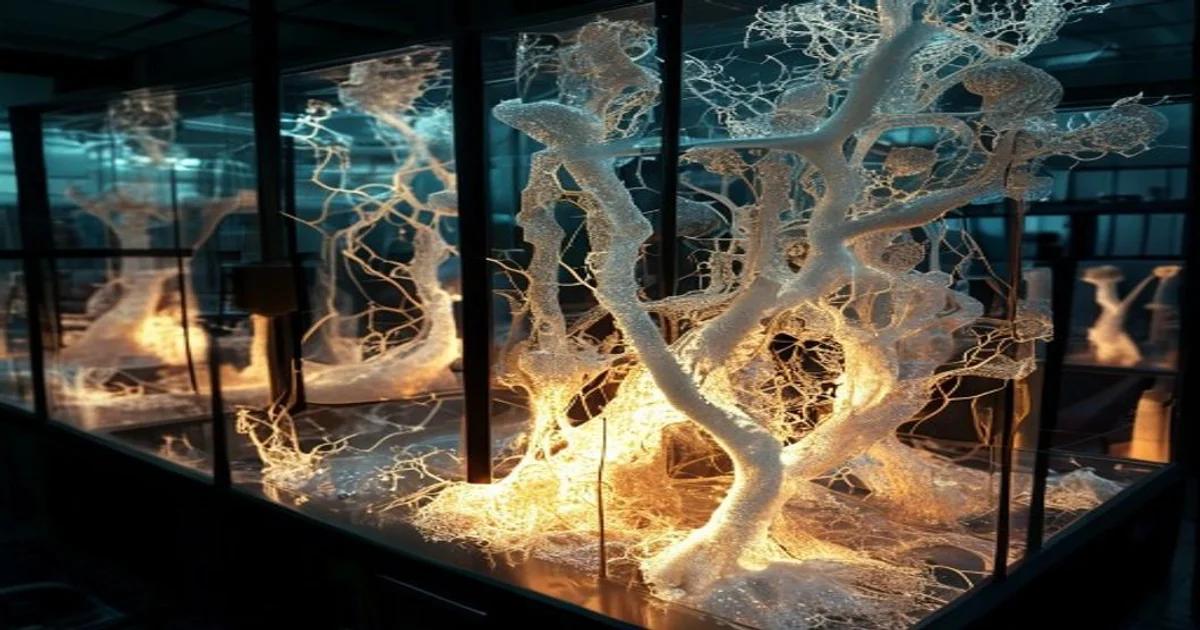
The Intersection of Mycology and Artificial Intelligence
The construction industry stands at a critical juncture. As global urbanization accelerates, the reliance on carbon-intensive materials like steel and concrete has become environmentally untenable. Enter the emerging field of AI-driven mycelium structural engineering—a discipline that merges the ancient biological intelligence of fungi with the computational precision of modern machine learning. By harnessing the rapid root-like growth of mycelium, engineers can 'grow' buildings rather than merely assembling them.
How AI Orchestrates Living Architecture
The fundamental challenge with biological materials is their inherent variability. Fungi do not grow with the uniformity of industrial manufacturing. This is where Generative AI becomes indispensable. By utilizing neural networks, researchers can now predict how a mycelium network will expand based on variables such as substrate composition, moisture levels, temperature, and light exposure.
'The integration of AI allows us to treat the mycelium not just as a filler material, but as a living structural component that we can program through environmental stimuli.'
Optimizing the Growth Matrix
AI models are now capable of executing multi-objective optimizations. They analyze thousands of simulated growth scenarios to determine the optimal density for a structural pillar. Once the design is set, robotic systems manage the nutrient distribution, ensuring that the mycelium consumes the organic substrate at a uniform rate to prevent weak points within the structure.
Generative Design and Structural Integrity
Traditional architectural design often relies on rigid, orthogonal geometry. Mycelium, however, thrives in complex, organic topologies. Generative algorithms allow designers to create biomimetic shapes—structures that mimic the efficiency of natural forms like bone or tree roots. These shapes are mathematically optimized to distribute weight evenly, leveraging the mycelium's natural compressive strength, which rivals that of some foams and timber products.
- Material Efficiency: AI ensures zero-waste by calculating exact growth parameters.
- Customization: Rapid prototyping allows for bespoke architectural components.
- Sustainability: The process captures carbon rather than emitting it.
The Future of Bio-Digital Manufacturing
The transition from experimental laboratory prototypes to industrial-scale application is the next frontier. We are seeing the rise of 'smart factories' where IoT sensors feed real-time growth data back to the central AI hub. If a specific patch of mycelium is growing too slowly, the system automatically recalibrates the humidity or nutrient inflow to compensate. This level of automation ensures that the final product maintains consistent structural performance despite the organic nature of the biological organism.
Addressing the Sustainability Mandate
Beyond just structural engineering, this technology represents a fundamental shift in our relationship with the built environment. As we move toward a circular economy, the ability to grow our own infrastructure—and compost it when it reaches the end of its lifecycle—is revolutionary. AI is the key to unlocking this potential at scale, providing the necessary precision to compete with legacy materials.
Technical Challenges and Ethical Considerations
While the promise is immense, the field faces significant hurdles.
- Scale-up feasibility: Scaling from lab petri dishes to full-scale buildings requires massive infrastructure.
- Regulatory approval: Building codes have yet to catch up with the unique properties of biological materials.
- Biological stability: Ensuring the mycelium is fully 'deactivated' post-growth to prevent unwanted regrowth is critical.
Despite these challenges, the trajectory is clear. The fusion of biological systems and computational design is not merely a trend; it is a necessary evolution of our approach to planetary stewardship. By automating the growth process, we are turning buildings into living systems that can eventually be designed to interact with their environment, perhaps even repairing their own cracks or filtering the surrounding air.
Conclusion
The marriage of artificial intelligence and mycology is rewriting the rules of structural engineering. As we continue to refine the algorithms that guide the growth of these natural structures, we unlock a future where our cities are not just composed of dead stone and steel, but of living, breathing, and carbon-negative organisms. The buildings of tomorrow are being designed in code, but they are born in the lab, nurtured by the relentless precision of the digital mind.