Introduction: The Seismic Shift in Digital Behavior
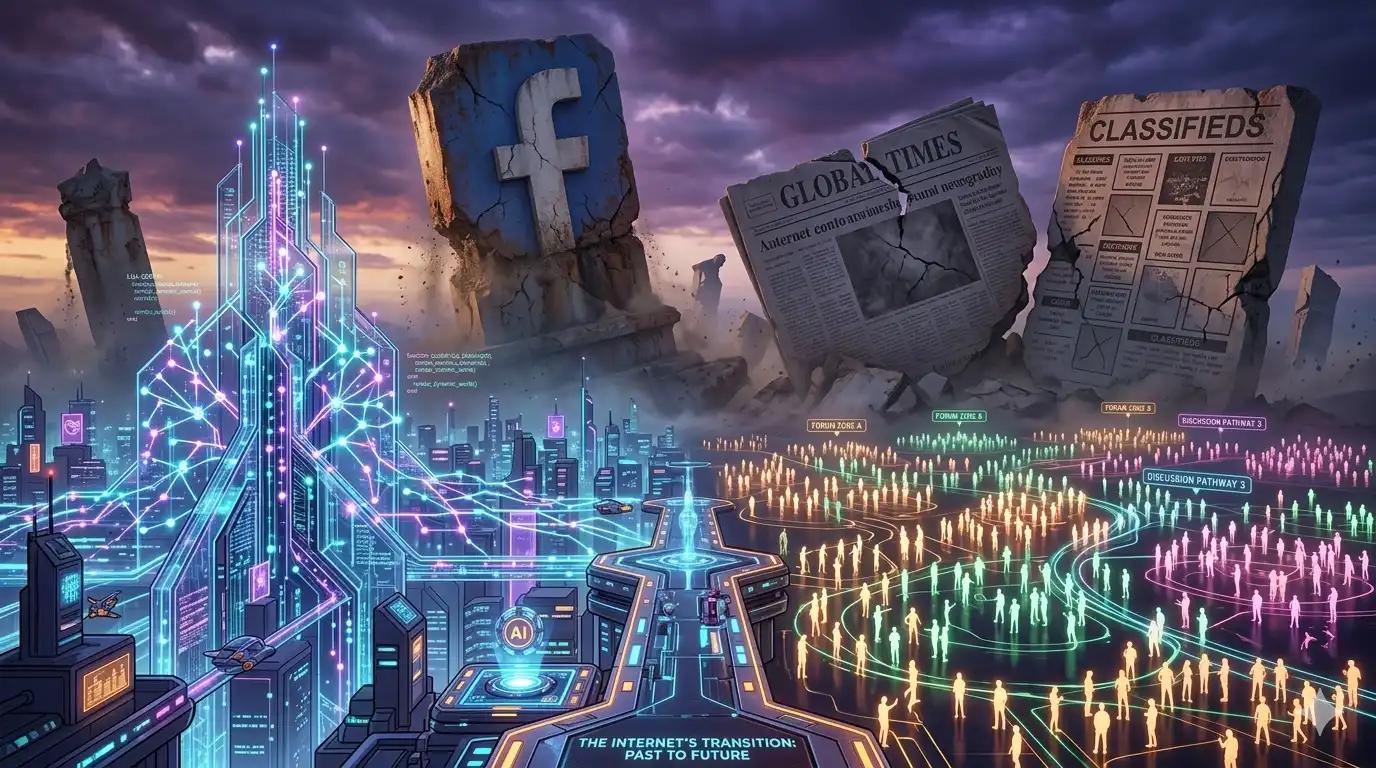
If you want to understand the future of the internet, you have to look at what people are searching for today—and what they have stopped searching for over the past five years. A comprehensive analysis of search interest data over a half-decade reveals a digital landscape undergoing a violent, structural transformation. We are witnessing the end of the Web 2.0 era, characterized by curated social media feeds and static classifieds, and the dawn of a bifurcated internet dominated by two extremes: hyper-advanced Artificial Intelligence and unfiltered, authentic human communities.
The data paints a stark picture. Legacy giants are bleeding user interest: searches for "facebook" have crashed by 60%, "craigslist" is down a staggering 80%, and "ebay" has lost half its search volume (-50%). Even the omnipresent query for "google" itself has declined by 30%. In their place, a new guard is rising. "ChatGPT" has registered as a "Breakout" query, experiencing growth so rapid it defies standard percentage metrics, while searches for "reddit" have surged by 90%. For digital marketers, tech entrepreneurs, and everyday users in the US, understanding the "why" behind these numbers is critical for navigating the internet in 2026 and beyond.
Explaining the Technology: The Drivers of Change
This massive migration of user attention isn't happening in a vacuum. It is being driven by fundamental changes in technology and human psychology regarding trust and efficiency.
The Breakout of Generative AI
The explosive trajectory of "chatgpt" represents the commercialization of Large Language Models (LLMs) based on transformer architecture. For the first twenty years of the mainstream internet, finding information required a multi-step process: querying a search engine, parsing through a list of blue links, navigating ad-heavy websites, and extracting the relevant facts manually. Generative AI collapsed this funnel. By predicting text based on massive training datasets, AI models synthesize answers instantly. The technology moved us from an era of information retrieval to an era of instant cognitive synthesis.
The Reddit Renaissance and "Human-in-the-Loop" Search
Simultaneously, the 90% increase in searches for "reddit" highlights a technological backlash. As the web became flooded with algorithmically generated content, SEO-optimized fluff, and aggressive affiliate marketing, the perceived trustworthiness of standard search results plummeted. Users adopted a new technological behavior: appending "reddit" to their Google queries. By doing so, they explicitly bypass traditional websites to search within Reddit's massive database of highly specific, heavily moderated, and—most importantly—human-vetted forums. It is a technological workaround to find authentic human consensus in an increasingly automated digital world.
Practical Applications: Adapting to the New Intent
These shifting trends require a total overhaul of how businesses and creators approach their digital presence in the US market.
- SEO is Dead, Long Live Community SEO: Optimizing for standard keywords is yielding diminishing returns. With searches for traditional news and platforms dropping, brands must pivot to where the conversation is actually happening. This means managing brand reputation on Reddit, establishing presences in niche Discord servers, and ensuring your product is recommended by actual humans in organic threads.
- Building AI-Ready Content: Because users are increasingly asking AI for answers rather than searching Google, content must be structured for LLM ingestion. Providing clear, highly structured, original data ensures that when an AI model synthesizes an answer for a user, your brand is cited as the authoritative source.
- Sunsetting the "Craigslist" Model: The 80% drop in Craigslist highlights the death of clunky, text-based, unverified transactional platforms. Consumers now demand algorithmic matching, verified identities, and seamless UI—features standard in modern marketplace apps that have eaten the legacy classifieds market.
The Advantages of the New Internet Ecosystem
While the decline of legacy platforms might seem alarming to traditional businesses, the new digital ecosystem offers incredible advantages for the end-user.
First, the speed of problem-solving has exponentially increased. Whether it's debugging a complex piece of code via ChatGPT or finding the exact solution to a home repair issue on a specific Reddit thread, users are bypassing the friction of the old web. Second, there is a renaissance of deep, niche interests. Instead of the broad, superficial engagement demanded by Facebook's algorithmic feed, users are finding highly engaged, passionate communities that cater to their exact specificities.
Limitations: The Dangers of the AI-Community Binary
This new paradigm, however, is fraught with limitations. The reliance on AI introduces the pervasive risk of "hallucinations"—plausible-sounding but entirely fabricated information generated by the model. As users blindly trust AI for rapid answers, the spread of misinformation at scale becomes a severe threat.
On the community side, the 90% surge in Reddit reliance creates a single point of failure. As Reddit goes public and focuses heavily on monetization and API restriction, the very authenticity that drew users to the platform is at risk. The "enshittification" of these trusted forums—where they become just as ad-heavy and corporatized as the platforms they replaced—is a looming limitation to this human-centric search strategy.
Future Outlook: Synthesizing AI and Community
Looking toward the end of the decade, the most successful digital platforms will be those that merge these two opposing trends. We will see the integration of AI directly into community platforms—not to generate fake posts, but to summarize massive threads, moderate toxic behavior, and match users with the exact human expert they need. The internet is splitting into the synthetic and the hyper-authentic; the future belongs to those who know how to navigate both simultaneously.