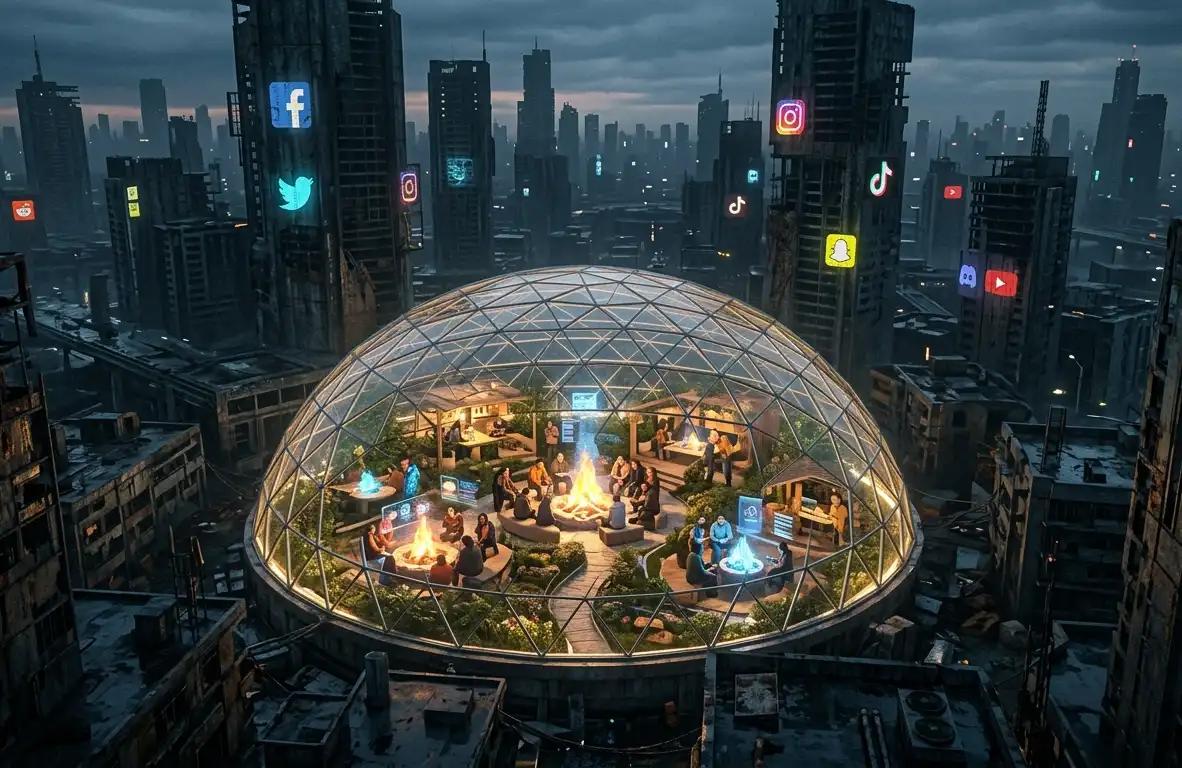
The Collapse of the Infinite Scroll
We are witnessing the greatest digital migration in the history of the internet. For the better part of the 2010s, the global population was corralled into massive, centralized algorithmic feeds. We were told that "connecting the world" meant participating in a single, infinite scroll dictated by opaque corporate algorithms. However, the five-year search data culminating in 2026 paints a drastically different picture. Facebook, the quintessential giant of the social era, has hemorrhaged a staggering 60% of its search interest. In stark contrast, platforms built on the foundation of niche communities and user-moderated discourse are experiencing explosive growth. Reddit has surged by 90%, and Discord has expanded by an astonishing 110%. This is not a mere fluctuation in user preference; it is a fundamental rejection of the broadcast model of social media.
To understand this shift, we must look at the psychological toll of the modern web. Users have developed acute algorithmic fatigue. The traditional feed became a battleground of sponsored content, manufactured outrage, and, more recently, a flood of perfectly coherent but ultimately soulless AI-generated text. In an ocean of synthetic information, authenticity has become the rarest and most valuable commodity on earth. People are no longer looking for "friends" in the traditional social network sense; they are desperately searching for "peers"—real humans with verified experiences.
"The era of Big Social was an anomaly. Humans were never meant to exist in a global room with three billion people screaming at once. We are retreating to the village, the guild, and the tavern. We are returning to the community."
The "Human-Verified" Premium: Why Reddit is Winning SEO
The 90% growth in Reddit searches reveals a fascinating evolution in human search behavior. When a modern user wants to buy a vacuum cleaner, find a coding solution, or read a movie review, they no longer trust standard web articles. They know those articles are likely optimized by SEO agencies and written by language models. Instead, they append the word "reddit" to their Google query. They do this because they are looking for the "Human-Verified" premium.
Reddit's architecture—based on pseudonymous identities, community moderation, and the brutal honesty of the upvote/downvote system—makes it highly resistant to corporate astroturfing. A fake review on a standard e-commerce site sits unchallenged; a fake review on Reddit is aggressively dismantled by knowledgeable users in the comments within minutes. In 2026, a brand's reputation is not dictated by their public relations department, but by the prevailing sentiment in their specific industry subreddit. For digital marketers, this means the old playbook is dead. You cannot simply buy attention on Reddit; you must earn authority through transparent, value-driven participation.
Discord: The Digital Third Place
If Reddit represents the asynchronous global forum, Discord represents the real-time living room. Growing by 110%, Discord has transcended its origins as a voice-chat app for gamers to become the premier infrastructure for modern communities. Sociologists talk about the "Third Place"—a location outside of home (the first place) and work (the second place) where people gather to socialize, like a coffee shop or a park. As physical third places have declined, Discord has filled the void.
In 2026, everything from massive open-source software projects to exclusive financial trading groups operates on Discord. Its success is rooted in its anti-algorithmic nature. There is no feed. There is no viral reach. You are either invited into the server, or you are not. This exclusivity and focus on real-time, synchronous communication creates incredibly high-trust environments. The shift toward Discord signifies that users are actively choosing intimacy and depth of connection over the shallow, performative metrics of likes and retweets.
The Facebook Marketplace Anomaly
Amidst the 60% decline in general Facebook interest, there is a glaring anomaly: Facebook Marketplace has seen a breakout growth of 250%. How does a dying social network house one of the fastest-growing utilities on the internet? The answer lies in the concept of localized trust. While users despise the Facebook newsfeed, they rely heavily on the platform's real-name policy for local commerce. Buying a used bicycle from a neighbor feels infinitely safer when you can see their profile and mutual friends. This proves that legacy platforms can survive, but only if they transition from being "social ecosystems" to "utility providers." Marketplace stripped away the politics and the algorithms, leaving only pure, peer-to-peer economic utility.
The Dead Internet Theory and the Push for Authenticity
The rise of these closed and semi-closed communities is closely tied to the "Dead Internet Theory"—the idea that the majority of the public web is now populated by bots and AI algorithms talking to each other. While an exaggeration, the underlying fear is real. The search trends for "Gmail Login" security (+80%) and "Internet Speed Test" (+30%) show a population that is highly technical and highly protective of their digital infrastructure. They know how the internet works, and they are actively building walls to keep the synthetic noise out.
This creates a massive challenge for traditional media. Legacy news outlets like CNN and Yahoo have seen declines of up to 40%. The modern user does not want the news handed down from a corporate anchor; they want to experience the news as a community event. Breaking events are now dissected in real-time on Reddit megathreads and Discord voice stages, where thousands of users fact-check and analyze raw footage collaboratively. The monopoly on truth has been permanently decentralized.
Marketing in the Post-Social Era
For brands trying to navigate 2026, the mandate is clear: abandon the megaphone and join the campfire. Standard display ads and sponsored posts yield diminishing returns because they exist in the algorithmic spaces that users are actively fleeing. The future of marketing is community management.
- Value-First Engagement: Brands must provide free, un-gated value to a subreddit or Discord server for months before attempting to extract any commercial gain.
- Founder Transparency: Faceless corporations fail in community spaces. CEOs and product managers must interact directly with the user base, fielding brutal feedback without PR filters.
- Fostering Evangelists: True growth comes from identifying the top 1% of your community and empowering them to advocate for your brand organically.
Conclusion: The Return to the Village
The 60% decline of Facebook and the meteoric rise of Reddit and Discord tell a unified story. The grand experiment of treating human social interaction as a scalable, algorithmic commodity has failed. The internet is healing by fracturing. We are witnessing a return to the digital village—smaller, highly moderated, deeply passionate groups of individuals who share common goals and mutual trust.
As artificial intelligence continues to lower the cost of content creation to zero, the only remaining differentiator will be authentic human connection. The platforms that facilitate this connection without exploiting it will define the next decade of the web. The great migration has already happened; the only question left is whether your brand is standing in the empty town square, or sitting by the fire in the new digital village.