
Introduction: The New Digital Routine
When analyzing digital search trends over a five-year horizon, it becomes clear that human attention is a zero-sum game. As interest in traditional, passive media formats like cable "news" drops (-30%) and legacy platforms fade, users are actively redirecting their time toward interactive, participatory experiences. Two of the most striking data points in recent history perfectly illustrate this: the explosive 70% growth in searches for "roblox" and the absolute "Breakout" phenomenon of the daily puzzle game "wordle."
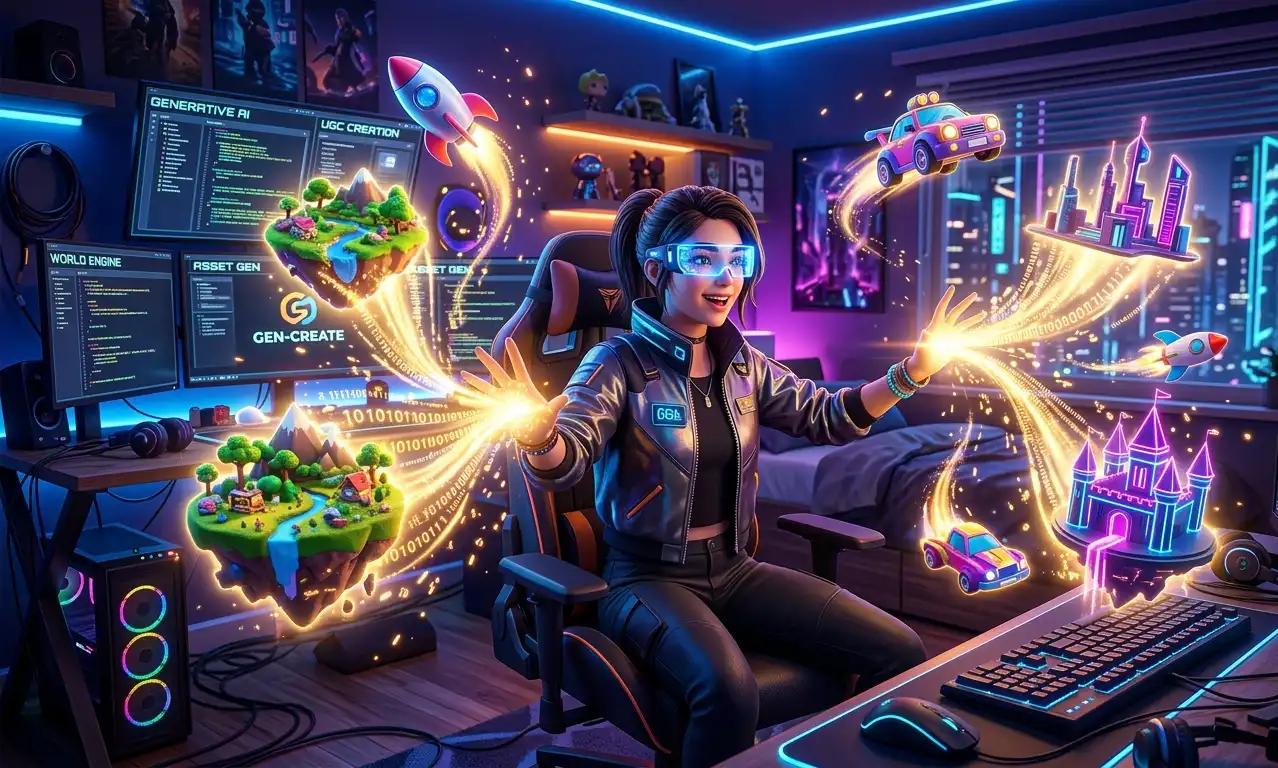
These aren't just isolated gaming trends; they are indicators of a broader behavioral shift in the US market. Consumers no longer just want to consume content; they want to create it, participate in it daily, and share it. Crucially, the engine driving the sustained, massive growth of platforms like Roblox is the silent integration of Artificial Intelligence. By lowering the barrier to entry for content creation, AI is turning everyday users into game developers, ushering in the golden age of User-Generated Content (UGC) in the metaverse.
Explaining the Technology: Generative AI as the Ultimate Creator Tool
To understand the 70% surge in Roblox's popularity, we have to look past the blocky graphics and focus on the underlying creator technology.
The Democratization of Code
Historically, building a 3D game required years of learning complex programming languages and 3D modeling software. Today, generative AI has entirely dismantled that barrier. Platforms are integrating LLMs directly into their creator studios. Now, a teenager on Roblox doesn't need to write hundreds of lines of Lua code to make a car drive; they can simply type a prompt: "Generate a script for a sports car with realistic suspension physics," and the AI writes the code instantly. This democratization of creation is fueling a massive influx of diverse, highly engaging mini-games on the platform.
Generative 3D Assets and Textures
Beyond code, AI is revolutionizing visual creation. New AI models allow users to generate custom 3D textures, skyboxes, and even basic 3D models using nothing but text prompts. This means the speed at which new, expansive worlds are built inside platforms like Roblox has multiplied exponentially, ensuring players always have fresh, captivating content to explore, keeping search intent high and consistent.
Practical Applications: The Stickiness of Digital Habits
The data also reveals the immense power of daily digital utility. While massive platforms grow, simple, highly focused tools capture deep user loyalty.
- The "Wordle" Phenomenon: Wordle achieved "Breakout" status by mastering the psychology of the digital habit. It demanded only three minutes a day, offered a universal challenge, and provided a highly shareable visual output. It proved that in an era of infinite, algorithmic scrolling, users crave finite, achievable daily tasks.
- AI in Everyday Utilities: This same desire for immediate utility is seen in the steady growth of queries like "calculator" (+8%) and the massive surge in "weather tomorrow" (+250%). Tech companies are noticing. The future involves integrating AI agents directly into these utilities—where your weather app doesn't just show rain, but actively advises you to reschedule your outdoor run based on your synced calendar.
- Educational Gamification: The underlying tech behind Roblox is increasingly being used for educational simulations, allowing teachers to spin up interactive historical environments or physics labs using simple AI text commands.
The Advantages of AI-Powered UGC
The primary advantage of integrating AI into gaming and metaverse platforms is the explosion of diversity in content. When you remove the technical bottleneck of coding, you unlock the pure creativity of millions of users who previously couldn't participate. This leads to incredibly niche, highly tailored experiences that massive AAA game studios could never justify building financially. It shifts the economic model from a few huge studios pushing content down to consumers, to millions of micro-creators building a self-sustaining digital economy.
Limitations: Quality Control and Moderation
The rapid generation of content via AI introduces severe challenges in moderation. If millions of users can generate scripts and 3D models instantly, the volume of potentially malicious, copyrighted, or inappropriate content scales just as fast. Platforms like Roblox are forced to deploy advanced AI counter-measures just to police the content being generated by other AI tools.
Furthermore, there is the risk of the "sea of mediocrity." When creation is effortless, the platforms can become flooded with low-effort, AI-generated junk games, making it difficult for players to discover truly innovative, high-quality experiences, potentially leading to platform fatigue.
Future Outlook: The Metaverse is Prompt-Driven
As generative AI becomes faster and more sophisticated, the distinction between "player" and "creator" will vanish entirely. In the near future, the most popular games will not be static applications you download; they will be dynamic environments that generate themselves in real-time, responding instantly to the spoken prompts and desires of the players exploring them. The metaverse will not be programmed; it will be prompted.