The Dawn of a New Era in Cultural Heritage Preservation
Cultural heritage, encompassing tangible artifacts, intangible traditions, and natural landscapes, forms the bedrock of human identity and collective memory. Its preservation is not merely an academic endeavor but a moral imperative, ensuring that future generations can learn from and connect with the past. However, this heritage is under constant threat from natural decay, environmental factors, conflict, and the relentless march of time. Traditional preservation methods, while invaluable, often struggle with the sheer scale, fragility, and complexity of these challenges. Enter Artificial Intelligence (AI) – a transformative force poised to redefine how we document, restore, protect, and make accessible the world's irreplaceable cultural treasures. The integration of advanced computational techniques, machine learning algorithms, and deep neural networks offers unprecedented capabilities, moving beyond conventional limitations to provide precision, scale, and insight previously unimaginable. This article delves into the profound impact of AI on cultural heritage preservation, exploring its diverse applications, the ethical considerations it raises, and the promising future it heralds.
The Urgent Need for Digital Transformation
The vulnerability of cultural heritage necessitates proactive and innovative solutions. From ancient manuscripts crumbling into dust to historical sites eroding under changing climates, the clock is ticking. Traditional manual cataloging, restoration, and archival processes are labor-intensive, time-consuming, and often expose delicate objects to further risk. Moreover, the physical barriers to accessing many heritage sites or collections limit their global impact and educational potential. The digital transformation enabled by AI addresses these critical needs, offering pathways to overcome physical decay, expand accessibility, and create robust, resilient records for eternity.
AI's Transformative Role in Documentation and Digitization
One of the most immediate and impactful applications of AI in cultural heritage lies in its ability to dramatically enhance documentation and digitization efforts. The creation of high-fidelity digital surrogates is the first crucial step towards long-term preservation and broader accessibility.
3D Reconstruction and Photogrammetry with AI
AI algorithms are revolutionizing 3D reconstruction techniques, particularly in photogrammetry and laser scanning. Where traditional methods might require extensive manual processing to align images or clean point cloud data, AI-powered software can automate these tasks with remarkable accuracy and speed. Computer vision algorithms can analyze thousands of photographs of an object or site, automatically identifying key features, matching points, and reconstructing detailed 3D models. This is particularly vital for large-scale sites like ancient cities or complex archaeological excavations, where manual mapping would be prohibitively slow and expensive. For instance, projects digitizing damaged historical buildings use AI to stitch together drone imagery, creating precise digital twins that capture every architectural detail, even when parts are inaccessible or hazardous.
AI also assists in 'filling the gaps' in incomplete data. When dealing with fragmented artifacts or partially destroyed sites, generative AI models can infer missing sections based on existing patterns, historical records, and comparative analysis with similar objects. This predictive modeling doesn't replace archaeological findings but provides invaluable hypotheses for restoration efforts and virtual reconstructions. The result is a comprehensive, precise, and easily shareable digital record, protecting heritage from the ravages of time and conflict.
Textual and Linguistic Analysis for Archival Heritage
Ancient texts, manuscripts, and historical documents often suffer from degradation, illegibility, or are written in obscure languages. AI, particularly Natural Language Processing (NLP) and Machine Learning (ML), offers powerful tools for their analysis and preservation.
- Optical Character Recognition (OCR) for Ancient Scripts: Advanced OCR systems, trained on diverse historical scripts, can now accurately transcribe faded, damaged, or handwritten documents. This goes beyond simple character recognition, often incorporating context and linguistic models to interpret challenging passages, leading to the digitization of vast archives previously inaccessible due to their condition or script complexity.
- Machine Translation and Lexicography: AI-powered machine translation can help scholars decipher texts in extinct or rarely understood languages. While not perfect, it provides a crucial starting point for human experts, significantly accelerating the translation process and broadening access to ancient knowledge. Furthermore, AI can assist in building digital dictionaries and lexicons for these languages, mapping linguistic evolution and cultural connections.
- Stylometric Analysis: AI can identify authors, dates, and geographic origins of anonymous texts by analyzing writing styles, vocabulary choices, and grammatical structures. This application helps historians attribute previously unidentified works, resolve scholarly debates, and gain deeper insights into historical literary traditions. For example, AI has been used to analyze the 'Dead Sea Scrolls,' identifying scribal hands and aiding in the reconstruction of fragmented texts.
Restoration, Reconstruction, and Anomaly Detection
Beyond documentation, AI is making profound inroads into the actual restoration and preventative care of cultural heritage assets.
Virtual Restoration and Digital Inpainting
Many artifacts are fragmented, discolored, or severely damaged. Physical restoration is often risky, irreversible, and requires highly specialized skills. AI offers a non-invasive, reversible alternative through virtual restoration. Deep learning algorithms, particularly Generative Adversarial Networks (GANs), can 'repaint' missing sections of murals, 'reconstruct' fragmented pottery, or 'repair' faded photographs with astonishing realism. These models learn patterns from existing undamaged portions of an artwork or from similar historical pieces, generating plausible reconstructions that adhere to the original style and aesthetic. This allows curators to experiment with different restoration hypotheses without touching the original artifact. It also enables the public to view artifacts as they might have appeared in their prime, enhancing appreciation and understanding.
Predictive Maintenance and Degradation Modeling
One of AI's most powerful applications is its ability to predict future degradation and identify early signs of damage, enabling proactive conservation strategies. This moves beyond reactive repair to preventative care.
- Environmental Monitoring: AI systems can integrate data from various sensors – temperature, humidity, light, vibration, pollution – within museums, archives, or outdoor heritage sites. By analyzing these continuous data streams, AI can identify anomalous patterns or gradual shifts that might indicate environmental stress, such as fluctuating humidity affecting a painting or increased seismic activity near an ancient ruin. Alerts can be triggered for curatorial staff, allowing them to adjust environmental controls or deploy protective measures before significant damage occurs.
- Material Science and Degradation Prediction: Machine learning models can be trained on datasets detailing the chemical composition of materials and their known degradation pathways under various conditions. This allows AI to predict how different materials (e.g., specific types of stone, paper, fabric) will degrade over time given certain environmental exposures. Such predictions inform material selection for new restorations, highlight particularly vulnerable artifacts, and guide the development of new conservation materials and techniques. For instance, AI can model the impact of air pollution on marble statues or the effects of light exposure on pigments, suggesting optimal display conditions.
- Anomaly Detection in Structure: For large structures like historical buildings or bridges, AI can analyze structural monitoring data (e.g., from strain gauges, tiltmeters) to detect subtle anomalies that may signal structural weakness or impending failure. Computer vision can be used with drones to inspect facades, identifying cracks, spalling, or vegetation encroachment far more efficiently and safely than manual inspections. Early detection of such issues can prevent catastrophic damage and significantly reduce repair costs.
Enhancing Accessibility and Engagement
AI doesn't just preserve; it also democratizes access to and enhances engagement with cultural heritage, breaking down geographical and physical barriers.
Virtual and Augmented Reality Experiences
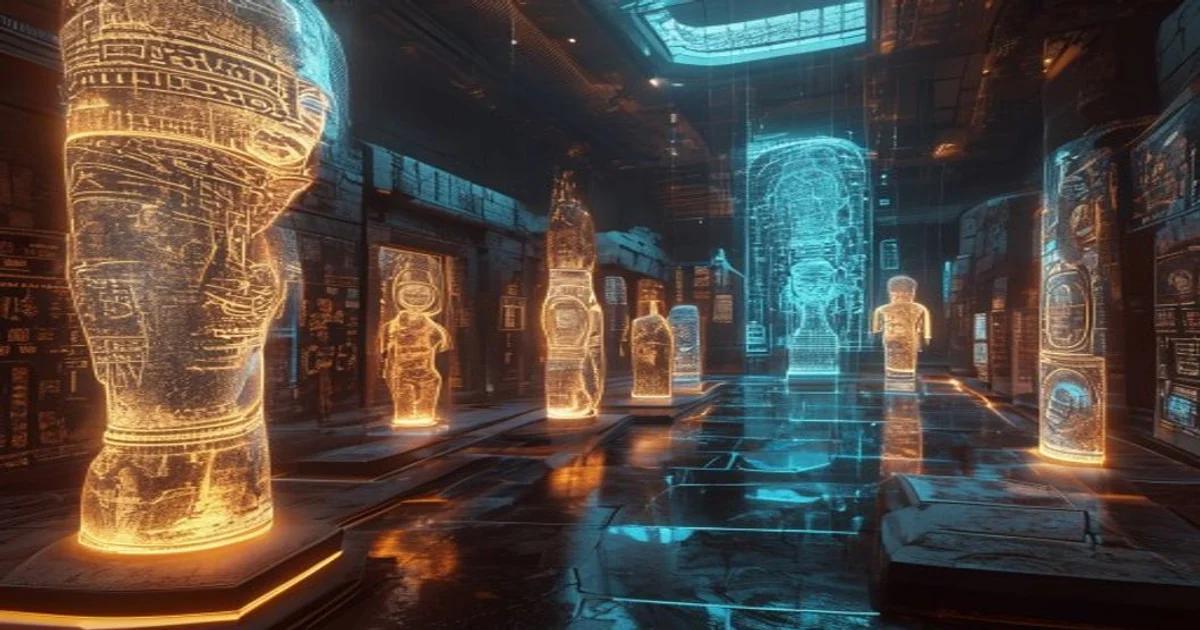
By leveraging AI-generated 3D models and reconstructions, virtual reality (VR) and augmented reality (AR) technologies offer immersive experiences that transport users directly into historical sites or allow them to interact with artifacts virtually. AI helps in creating realistic textures, lighting, and environmental dynamics within these virtual spaces.
- Virtual Museum Tours: Users can explore ancient cities like Pompeii or the temples of Angkor Wat from anywhere in the world, with AI guiding their path and providing contextual information. This is particularly valuable for sites that are physically inaccessible, delicate, or located in politically unstable regions. It also allows for 'reconstructions' of lost heritage, like the Buddhas of Bamiyan, which can be experienced virtually as they once were.
- AR Overlays for On-Site Experience: At actual heritage sites, AR apps can overlay historical imagery or 3D reconstructions onto a user's live view through a smartphone or smart glasses. Imagine seeing a Roman villa's original frescoes superimposed on its ruins, or witnessing a gladiatorial combat virtually unfold in the Colosseum. AI enhances these experiences by recognizing user location and context, dynamically adjusting the AR content.
Personalized Learning and Tour Guides
AI-powered systems can tailor educational content and museum experiences to individual users, making cultural heritage more engaging and relevant.
- Intelligent Chatbots and Virtual Guides: AI chatbots, trained on vast archives of historical and artistic data, can act as personalized virtual tour guides, answering questions about artifacts, artists, historical periods, and cultural contexts. They can adapt their explanations based on the user's prior knowledge, interests, and learning style, offering a truly bespoke educational journey.
- Content Recommendation Systems: Similar to streaming services, AI can recommend related artifacts, exhibitions, or historical narratives to visitors based on their interaction history and expressed interests. This encourages deeper exploration and discovery within vast collections, fostering a more profound connection to the material.
- Gamification of Learning: AI can facilitate the development of interactive games and simulations that teach about history and culture. For example, an AI could generate challenges based on historical events or allow players to virtually 'curate' their own museum exhibit, enhancing learning through active participation.
Challenges and Ethical Considerations
Despite the immense potential, the deployment of AI in cultural heritage preservation is not without its challenges and ethical dilemmas. Addressing these issues is crucial for ensuring that AI serves to genuinely safeguard and enrich human heritage, rather than inadvertently distorting or diminishing it.
Data Bias and Representativeness
AI systems are only as good as the data they're trained on. If historical data used to train AI models is biased – reflecting colonial perspectives, neglecting marginalized communities, or disproportionately featuring certain types of artifacts – the AI's outputs will perpetuate and amplify these biases. For example, an AI trained primarily on European art may struggle to accurately restore or interpret artifacts from non-Western cultures, potentially generating ethnocentric reconstructions or misinterpreting cultural nuances. Ensuring diverse, inclusive, and rigorously curated datasets is paramount to mitigate these biases and ensure AI tools are representative of the global tapestry of human heritage.
Authenticity and Interpretation
When AI virtually 'restores' or 'completes' a damaged artifact, questions of authenticity inevitably arise. Is an AI-generated reconstruction truly representative of the original, or is it an algorithmic interpretation? The line between informed reconstruction and speculative creation can become blurred. There's a risk that AI-generated 'perfected' versions might overshadow the historical reality of fragmented or incomplete heritage, potentially altering our understanding and appreciation of its journey through time. Transparency about AI's role in any reconstruction is essential, clearly distinguishing between original material and AI-generated content. Furthermore, the interpretation of cultural artifacts is often nuanced and debated among human scholars; delegating this to AI requires careful oversight and ethical frameworks to avoid reductionist or culturally insensitive interpretations.
Digital Divide and Resource Allocation
The implementation of advanced AI technologies requires significant financial investment, technical expertise, and robust digital infrastructure. This creates a potential 'digital divide,' where institutions and nations with fewer resources may be excluded from the benefits of AI preservation. The global distribution of cultural heritage is vast and often concentrated in regions with limited technological capabilities. Without equitable access to AI tools and training, there's a risk that the preservation gap between resource-rich and resource-poor areas could widen, leading to further marginalization of already vulnerable heritage. International collaborations, open-source initiatives, and capacity-building programs are vital to ensure that AI's benefits are shared equitably across the globe.
Copyright, Ownership, and Access
Digitization efforts, particularly with AI, raise complex questions about copyright and ownership of digital surrogates. Who owns the 3D model of an ancient statue? Who controls access to the AI-enhanced digital archive of a historical manuscript? These are not trivial concerns, especially when considering indigenous heritage and traditional knowledge, where communities often hold ancestral rights. Clear policies regarding data ownership, intellectual property, and equitable access are needed to prevent exploitation and ensure that digitized heritage benefits its original custodians and the broader global community.
The Future Landscape: Collaborative Intelligence
The future of AI in cultural heritage preservation lies not in AI replacing human experts but in fostering a powerful synergy – what is often termed 'collaborative intelligence.' This involves AI tools augmenting human capabilities, handling laborious tasks, and providing insights, while human experts provide critical judgment, contextual understanding, and ethical oversight.
Human-AI Synergy in Conservation
Conservationists, archaeologists, historians, and art historians will increasingly work alongside AI systems. AI can process vast amounts of data, identify patterns, and generate initial hypotheses at speeds impossible for humans. Human experts then apply their deep knowledge, intuition, and ethical reasoning to interpret these outputs, refine models, and make final decisions. For example, an AI might highlight areas of a painting that show unusual chemical degradation, prompting a human conservator to investigate further with specialized techniques. This division of labor allows each to leverage their unique strengths, leading to more efficient, accurate, and ethical preservation outcomes.
Policy, Standardization, and Education
To maximize the positive impact of AI, concerted efforts are needed at policy and educational levels. Establishing international standards for AI-driven digitization, data archiving, and virtual reconstructions will ensure interoperability and consistency across projects. Furthermore, integrating AI literacy and digital humanities into academic curricula will train the next generation of heritage professionals to effectively utilize these powerful tools. Ethical guidelines and regulatory frameworks specifically for AI in cultural heritage will be essential to navigate challenges related to authenticity, bias, and access, ensuring that technology serves humanity's best interests in safeguarding its past.
The Rise of Generative AI and Immersive Storytelling
The rapid advancements in generative AI, particularly large language models (LLMs) and image/video generation, promise even more transformative applications. Imagine AI that can not only transcribe ancient texts but also narrate their stories in a culturally appropriate context, adapting to different audiences. Or AI that can generate historically accurate immersive experiences that evolve based on user interaction, allowing individuals to 'live' through historical events or 'meet' historical figures in highly realistic virtual environments. This shift towards immersive, interactive storytelling, driven by AI, could revolutionize how people connect with and understand their heritage, moving beyond passive observation to active engagement and empathetic understanding.
Conclusion
AI stands at the precipice of revolutionizing cultural heritage preservation, offering a beacon of hope against the relentless forces of decay and destruction. From meticulous digitization and sophisticated virtual restoration to proactive predictive conservation and immersive educational experiences, AI tools are expanding the horizons of what is possible. However, this powerful technology must be wielded with profound responsibility. Addressing issues of data bias, maintaining authenticity, ensuring equitable access, and establishing robust ethical frameworks are not mere afterthoughts but fundamental pillars for its successful and beneficial implementation. The future of cultural heritage preservation is a collaborative endeavor, one where the unparalleled analytical power of AI converges with the irreplaceable wisdom, empathy, and ethical judgment of human experts. This synergy promises not only to save our past but also to enrich our present and enlighten our future, ensuring that the legacy of human achievement endures for all generations.