
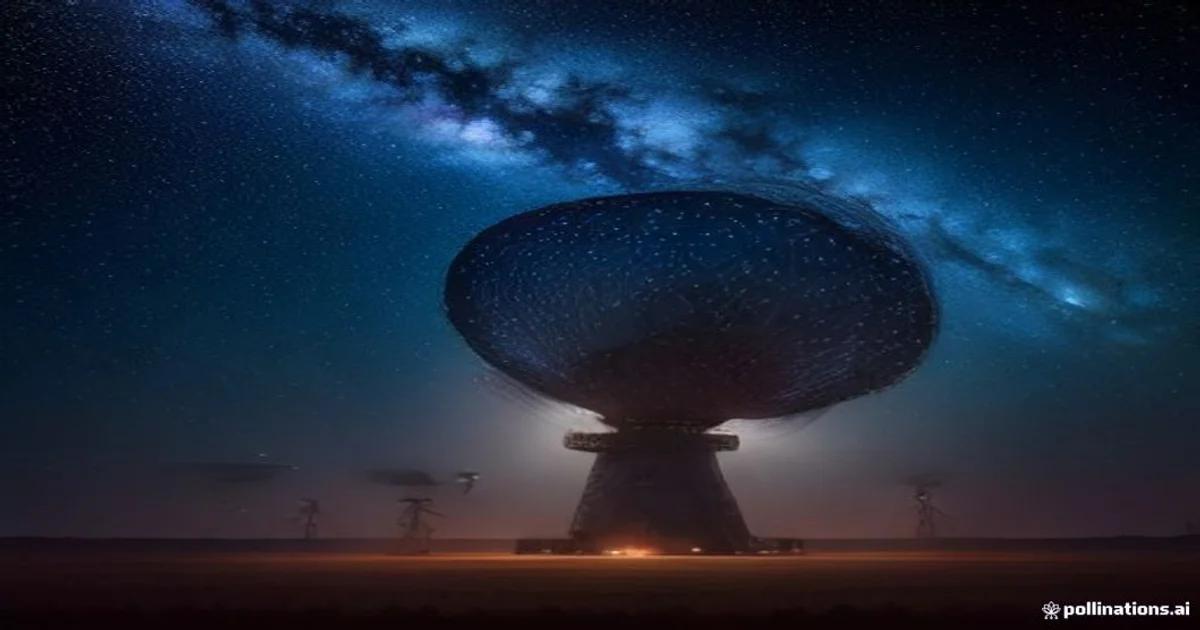
The Dawn of Algorithmic Astrobiology
The quest to determine whether we are alone in the universe has historically been defined by the limitations of human perception and hardware processing speeds. For decades, the Search for Extraterrestrial Intelligence (SETI) relied on relatively static signal processing methods. However, the paradigm is shifting. By leveraging AI-Driven Adaptive Astrobiological Signal Detection, researchers are moving beyond basic Fourier transforms to dynamic, pattern-recognizing architectures that can isolate faint anomalies in a sea of cosmic noise.
Overcoming the Signal-to-Noise Challenge
Space is inherently noisy. Pulsars, quasars, and terrestrial interference create a chaotic backdrop that renders traditional threshold-based detection nearly obsolete. Modern Deep Learning models, specifically convolutional neural networks (CNNs) and transformer-based architectures, excel at discerning 'structured' anomalies that imply non-random origin.
'The challenge is not finding signals, but distinguishing intelligent signatures from the roar of a violent, active universe,' says leading astrophysicist Dr. Elena Vance.
Adaptive Learning Architectures
Traditional algorithms are programmed with static parameters, making them unable to adapt to evolving signal profiles. Adaptive systems use reinforced feedback loops to improve their detection capabilities as they encounter new datasets. These systems can be described as follows:
- Real-time Feature Extraction: AI models strip away background radiation at the edge.
- Pattern Matching: Neural networks compare anomalies against known natural celestial emission signatures.
- Hypothesis Generation: The system dynamically flags potential 'technosignatures' for human review based on mathematical complexity scores.
Scaling with High-Performance Computing
Processing the sheer volume of data produced by modern arrays like the SKA (Square Kilometre Array) requires unprecedented computational power. By integrating Algorithms that operate on specialized AI hardware, the time to process data streams is reduced from months to mere hours. This speed is critical for transient signal analysis, where a repeating signal might be missed by long-latency processing.
Addressing the Ethics of Detection
The deployment of autonomous detection systems raises complex questions regarding verification. If an AI detects a potential signature, how do we confirm it without human bias? Current protocols require a multi-stage validation process where deep learning models function as the 'first responder,' followed by rigorous statistical verification by human-in-the-loop scientific committees.
The Future of Deep Space Synthesis
As we look forward, the marriage of AI and astrobiology will likely expand into multi-modal analysis. Combining radio frequency data with optical, infrared, and gravitational wave signals will create a holistic view of the cosmos. By training models on synthetic data that simulates potential intelligent artifacts, we prepare our systems to recognize things we have yet to conceive. This proactive approach to exploration defines the next era of discovery.
Conclusion
AI is no longer just a tool for processing data; it is the primary engine of discovery in modern astrophysics. By creating adaptive systems that can think, filter, and prioritize, we are essentially building a digital net capable of capturing the whispers of the stars. The journey to answer the ultimate question—'Are we alone?'—is now guided by the intelligence we created to find our companions in the dark.