
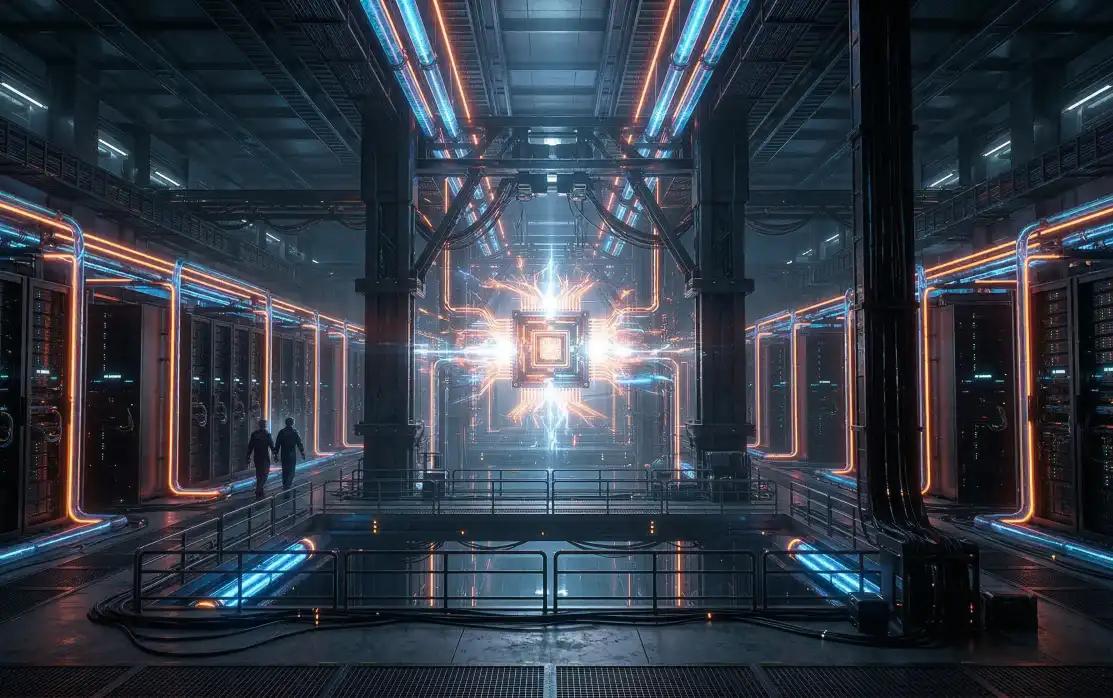
The Physical Limits of a Digital Revolution
When we interact with artificial intelligence, it feels like magic. We type a prompt into a sleek, minimalist interface, and seconds later, an essay, a piece of complex software, or a stunning piece of generative art appears. Because the interface is weightless and invisible, it is easy to succumb to the illusion that AI itself is weightless. However, the reality of March 2026 has violently shattered this illusion. Artificial intelligence is arguably the heaviest, most physically demanding technology humanity has ever created. Behind every autonomous agent and every generated image lies an unimaginably vast network of concrete data centers, roaring cooling fans, miles of high-voltage cabling, and custom-engineered silicon chips. The AI revolution has hit a physical wall, and that wall is made of energy and infrastructure.
Top technology analysts and telecommunications leaders are now issuing stark warnings: the boundless ambition of digital innovation is running headlong into the harsh realities of global power grids and water supplies. Training frontier large language models (LLMs) requires the orchestration of tens of thousands of high-performance GPUs running at maximum capacity for months. Even simple "inference"—the process of an AI model generating a response to a user prompt—consumes magnitudes more energy than a traditional web search. As the global adoption of AI scales exponentially, the single most critical constraint on the entire digital ecosystem in 2026 is no longer algorithmic capability; it is energy scarcity. We are witnessing a painful reckoning between what we want machines to do and what our planet can physically support.
"The single most critical constraint on the entire digital build-out in 2026 hinges upon energy scarcity. The massive compute demand for training frontier models is forcing a painful reckoning between boundless tech ambition and energy policy."
The Custom Silicon War: Meta's Pivot and the Move Away from Nvidia
To understand how desperately companies are trying to optimize their physical infrastructure, one only needs to look at the latest moves by industry giants. In early March 2026, Meta made headlines by announcing four new generations of custom, in-house AI chips—the MTIA 300, 400, 450, and 500 series. For years, the AI industry was almost entirely reliant on Nvidia, whose highly coveted GPUs powered everything from OpenAI's models to independent research clusters. However, the immense cost, extreme power requirements, and severe supply chain bottlenecks of relying on a single external vendor forced a strategic pivot.
Meta's decision to deploy its own silicon across its data centers by the end of 2027 is a blueprint for the future of Big Tech. These custom chips are hyper-optimized specifically for the workloads the company cares about most: deep recommendation algorithms, content ranking, and high-end generative AI inferencing. By controlling the hardware design, companies can dramatically improve the "performance-per-watt" metric. In an era where electricity is the ultimate limiting factor, shaving off a fraction of a cent in power consumption per AI inference translates to billions of dollars in savings and a massive competitive advantage. The era of generic hardware is ending; the future of AI belongs to vertically integrated systems where the algorithm and the silicon are designed to work together in perfect, energy-efficient harmony.
The Data Center Boom: Superfactories and Sovereign Clouds
As the silicon evolves, so too does the physical housing of the internet. The concept of the traditional "data center" is being replaced by the "AI Superfactory." These are sprawling complexes designed specifically for the thermal and electrical demands of modern machine learning. Because AI workloads pack computing power much more densely than traditional web hosting, the heat generated by these server racks is astonishing. Standard air-cooling systems are no longer sufficient; the industry is rapidly transitioning to advanced liquid cooling technologies, which unfortunately introduces severe stress on local water supplies.
This immense environmental footprint is causing friction with local communities and governments. Reports from the UK show local councils approving new AI datacentres despite severe warnings about emissions and grid strain. Governments are trapped in a dilemma: they desperately want to secure their position in the global AI economy to drive economic growth, yet they cannot ignore the staggering environmental cost. Furthermore, the geopolitical climate of 2026 is driving a trend known as "Geopatriation." Fearing political instability and supply chain disruptions, nations are demanding that their citizens' data and AI processing occur within their own borders on "Sovereign Clouds." This means that instead of a few massive data centers in optimized locations, companies are forced to build highly redundant, energy-hungry infrastructure across multiple different regions.
Infrastructure Component
- Compute Hardware
- Cooling Mechanisms
- Energy Requirement
- Location Strategy
Traditional Tech Era (2015-2022)
- Generic CPUs
- Standard HVAC (Air Cooling)
- Moderate and Predictable
- Centralized Global Hubs
AI Era (2026 onwards)
- Custom AI Silicon (GPUs, TPUs)
- Direct-to-Chip Liquid Cooling
- Exponential and Grid-Straining
- Distributed Sovereign Clouds
Dynamic Routing: Air Traffic Control for Computing Power
With hardware and energy at such a premium, efficiency has become a matter of survival. Technology leaders are implementing sophisticated management systems that act like "air traffic control" for AI workloads. Across distributed global networks, computing power is packed densely and routed dynamically. If a server rack in Nevada finishes a training run early, a queued inference job from London is instantly routed to that idle hardware. The goal is to ensure that no cycle of processing power and no watt of electricity ever sits unused.
This dynamic orchestration is crucial because it allows companies to maximize their existing infrastructure while they desperately build new facilities. It also highlights a fascinating irony: AI is being used to optimize the very infrastructure that powers AI. Machine learning models predict spikes in user demand, manage cooling systems to prevent overheating, and dynamically shift workloads across the globe to regions where electricity is currently cheapest or greenest (for example, shifting tasks to data centers powered by solar energy during peak daylight hours).
The Quantum Horizon: A Hybrid Computing Future
While custom chips and dynamic routing offer immediate relief, they are ultimately stopgap measures in the face of exponential demand. The true solution to the physical limits of AI lies on the bleeding edge of physics: Quantum Computing. In 2026, we are beginning to see the integration of hybrid computing architectures, where classical AI models work alongside early-stage quantum processors and traditional supercomputers.
In this hybrid model, classical AI excels at finding patterns in vast datasets, supercomputers handle massive brute-force simulations, and quantum computers are utilized to solve specific, highly complex mathematical problems—like modeling molecular structures for new materials that could theoretically conduct electricity without resistance (room-temperature superconductors). The recent stabilization of "logical qubits" (grouping physical quantum bits together to detect and correct errors) is a monumental step forward. While a purely quantum internet is still years away, the integration of quantum accelerators into AI superfactories promises to eventually break the current energy bottlenecks, paving the way for the next great leap in artificial intelligence.
Conclusion: The Price of Intelligence
The narrative of 2026 is that intelligence has a physical price. The AI revolution has proven that the digital world is inextricably tethered to the physical world. As we push the boundaries of what machines can reason and create, we are simultaneously testing the limits of our power grids, our water reserves, and our hardware engineering. The companies that will dominate the next decade are not just those that write the best software algorithms; they are the companies that master the brutally difficult logistics of energy procurement, heat dissipation, and custom silicon manufacturing. The battle for the future of AI is no longer just being fought in the cloud—it is being fought in the concrete foundations of the data center.