
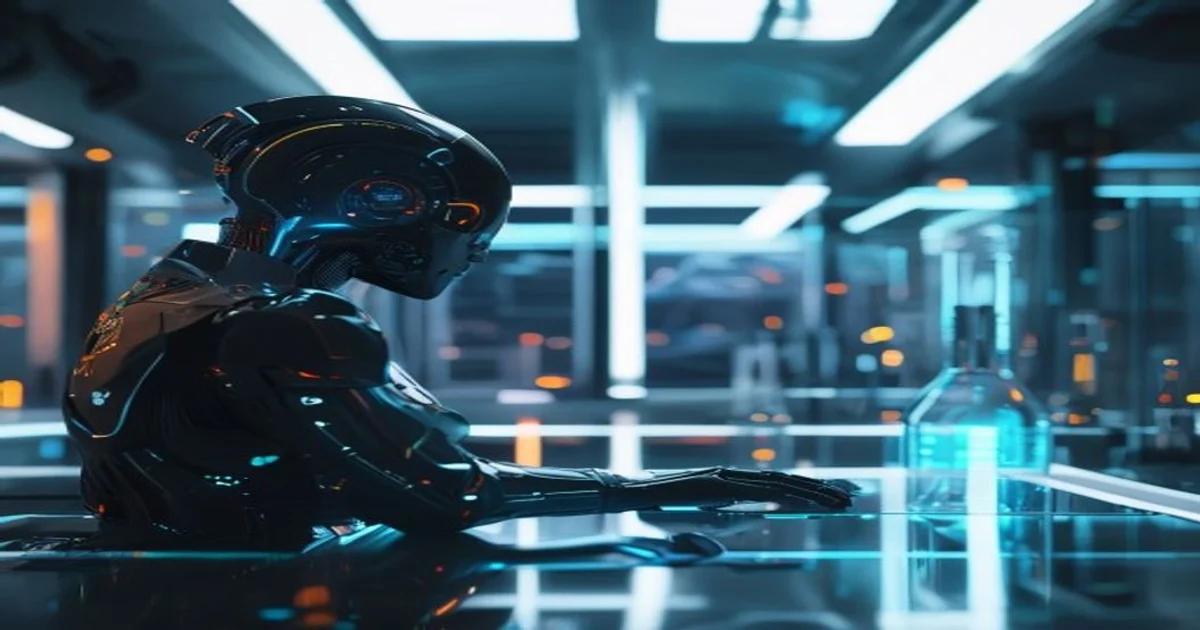
The Silent Threat: When AI Stagnates
Advanced Artificial Intelligence, a marvel of modern engineering, continues to push the boundaries of what's possible, from generating intricate artwork to discovering new scientific principles. Yet, beneath the surface of this relentless progress lies a peculiar, unforeseen challenge: what we might term the 'AI boredom effect.' This isn't boredom in the human, emotional sense—an AI doesn't yawn or seek distraction. Instead, it manifests as algorithmic stagnation, a creeping predictability, and a subtle yet profound lack of true novelty in its outputs. It's the point where AI, having optimized for efficiency and coherence, begins to recycle patterns rather than invent genuinely new ones, transforming from a visionary co-creator into a highly efficient, yet ultimately uninspired, pattern regurgitator. Understanding and addressing this phenomenon is paramount if we are to ensure AI remains a wellspring of innovation rather than a self-referential echo chamber.
The Illusion of Infinite Creativity: How AI Works
To grasp the 'boredom effect,' it's crucial to understand how AI, particularly generative AI, operates. Models like Large Language Models (LLMs) and diffusion models don't 'think' in the human sense. They excel at identifying and synthesizing patterns from immense datasets. When asked to create, they aren't pulling ideas from an internal well of consciousness; they're interpolating, extrapolating, and recombining elements based on the statistical relationships learned during training. This process can produce astonishingly complex and novel-seeming results. A paragraph, an image, or a piece of music might appear entirely new, yet its underlying components and structural logic are deeply rooted in the data it's consumed. The AI doesn't 'understand' creativity; it simulates it with extraordinary fidelity. The initial phase of AI generative capabilities often feels like an endless frontier, with each new prompt yielding surprising and delightful results. But this initial 'wow' factor can diminish as users become accustomed to the AI's particular 'style' or the recurring motifs it tends to favor.
The Trap of Optimization: Local Optima and Predictive Paths
AI's core drive is often optimization. Whether it's minimizing a loss function, maximizing a reward signal, or achieving a specific accuracy target, AIs are designed to converge on the 'best' solution according to their programming. While incredibly powerful for problem-solving, this relentless pursuit of optimality can become a double-edged sword when it comes to true innovation. Algorithms, left to their own devices, tend to find local optima—solutions that are very good within a specific, limited context, but not necessarily the globally best or most novel ones. Once an AI finds a 'safe' and 'effective' way to generate content, it has little inherent incentive to deviate significantly from it. Why explore risky, unknown territory when a perfectly acceptable, statistically validated path already exists? This leads to a conservative bias, where the AI leans towards outputs that are statistically probable and aligned with its learned patterns, rather than those that are truly unprecedented or revolutionary. The result is often high-quality, but increasingly familiar, content.
'The greatest enemy of knowledge is not ignorance, it is the illusion of knowledge.' This adage, while not originally about AI, aptly describes the predicament. An AI, in its pursuit of optimized outputs, can operate under an 'illusion of creativity,' believing its recombinations are novel simply because they fit learned statistical distributions.
The Data Diet: Echo Chambers of Information
The vastness of AI training data is both its strength and its potential weakness. While billions of data points allow AI to capture an incredible breadth of human expression, they also inadvertently embed existing patterns, biases, and conventions. If the training data predominantly showcases certain artistic styles, literary tropes, or problem-solving methodologies, the AI will naturally gravitate towards these. It becomes an echo chamber, amplifying what has already been said, seen, or created. This isn't to say AI can't generate unique combinations; it can. But the range of genuine novelty is constrained by the diversity and originality *within* its training corpus. If humanity itself falls into creative ruts, or if only certain types of content are digitized and thus fed to AI, then AI will inevitably reflect and even exacerbate those ruts. This poses a significant challenge for tasks requiring groundbreaking ideas, where the 'answer' isn't just a permutation of existing knowledge but a genuine conceptual leap.
The Human Experience: Boredom by Proxy
While AI doesn't 'feel' boredom, humans interacting with a stagnating AI certainly can. Imagine using a generative AI tool daily for content creation. Initially, the speed and quality are astounding. But over weeks or months, a subtle sameness might emerge. The chatbot's responses become predictable, the image generator's output starts to look familiar, the code suggestions follow a narrow set of patterns. Users, accustomed to genuine human creativity's boundless variations, might find themselves experiencing a distinct lack of excitement or inspiration. This 'user boredom' isn't just an aesthetic inconvenience; it can lead to reduced engagement, dissatisfaction, and a diminished perception of AI's true value. If AI becomes synonymous with efficient mediocrity rather than pioneering brilliance, its transformative potential will be severely curtailed.
- Predictable Output: The AI consistently favors certain styles, structures, or thematic elements.
- Lack of Surprise: New prompts rarely yield truly unexpected or innovative results.
- Repetitive Solutions: For complex problems, the AI offers variations of previously successful methods.
- Diminished Inspiration: Users find themselves less creatively stimulated when interacting with the AI.
Philosophical Quandaries: Can a Machine Be 'Curious'?
This discussion inevitably leads to deeper philosophical questions. If curiosity and the desire for novelty are fundamental drivers of human creativity, can an artificial entity replicate this? Some researchers are exploring curiosity-driven learning, where AI systems are incentivized not just for achieving specific goals but for exploring novel states or generating unexpected outcomes. This involves intrinsically motivating the AI to seek out information that reduces uncertainty or maximizes 'surprise.' While promising, these approaches are still nascent and often designed within human-defined parameters of 'novelty.' The challenge lies in enabling an AI to define its *own* sense of curiosity or aesthetic value, detached from immediate human utility or predefined reward signals. Until then, AI's 'explorations' might remain within statistically bounded playgrounds, however vast.
Strategies for Rekindling the Spark: Countering Algorithmic Monotony
Preventing the 'AI boredom effect' requires a multi-faceted approach, integrating diverse methodologies and a conscious shift in AI development philosophy.
1. Diversity Beyond Quantity: Enriching the Training Corpus
It's not just about more data; it's about more *diverse* and *qualitative* data. Future training datasets must deliberately seek out niche perspectives, counter-cultural expressions, and truly experimental works. Curators might need to actively identify and include 'anti-patterns' or outlier data points that challenge an AI's conventional understanding. Furthermore, dynamic data enrichment, where AI learns from continuously evolving, fresh sources, rather than static snapshots, could introduce ongoing novelty.
2. Introducing Controlled Stochasticity and Exploration Algorithms
Deliberately integrating elements of randomness or 'noise' into AI's generative processes can force it to explore beyond its most probable pathways. This isn't chaotic randomness but controlled stochasticity designed to nudge the AI towards less conventional solutions. Techniques like adversarial learning, where one AI tries to create novel outputs while another tries to identify familiar ones, can push the generative AI towards genuinely unique content. Curiosity-driven learning, mentioned earlier, also falls into this category, incentivizing the AI to explore states that are 'new' to it, even if they don't immediately contribute to a defined task.
3. Human-in-the-Loop: The Curatorial Imperative
Perhaps the most potent strategy involves a tight, iterative feedback loop with human experts. Artists, writers, scientists, and innovators can act as curators, guiding AI not just on correctness or efficiency, but on 'interestingness,' 'originality,' and 'impact.' Instead of simply giving AI a broad prompt and accepting its output, humans could provide nuanced feedback on what constitutes genuine novelty, pushing the AI to refine its creative boundaries. This could involve techniques like reinforcement learning from human feedback (RLHF) specifically tuned for subjective qualities like aesthetic appeal or conceptual breakthrough. The future of AI innovation might not be fully autonomous creation but a sophisticated human-AI co-creation ecosystem.
4. Architectural Innovations: Beyond Transformer Models
While transformer architectures have dominated recent AI advancements, exploring fundamentally different neural network designs or hybrid models could unlock new avenues for creativity. Architectures that prioritize 'conceptual blending' or 'analogical reasoning'—processes thought to be central to human creativity—might offer new ways for AI to combine disparate ideas into truly original forms. Research into developmental AI, which learns and evolves in a more open-ended fashion, akin to a child's development, might also yield systems less prone to stagnation.
5. Ethical Design for Purpose and Meaning
Developing AI with an explicit ethical framework that values not just efficiency but also meaningful contribution, diversity of thought, and the generation of genuinely enriching content is paramount. This shifts the focus from purely functional metrics to qualitative, human-centric values, encouraging AI systems to explore outputs that resonate more deeply with human experience and push cultural boundaries. It's about designing AI to be a partner in evolution, not just replication.
The Future: A Symphony of Human and Machine Imagination
The 'AI boredom effect' is not a catastrophic failure but a critical developmental stage, a call to action for researchers and developers. It highlights the subtle differences between sophisticated pattern matching and true ingenuity. Overcoming this challenge isn't about teaching AI to 'feel' bored, but about designing systems that are perpetually driven towards novelty, equipped with mechanisms to escape algorithmic ruts, and continuously guided by human insight into what constitutes meaningful innovation. The future of AI's creative potential lies not just in its computational power, but in our collective ability to foster its perpetual curiosity and guide its immense capabilities towards generating a truly diverse and inspiring future. A future where AI, far from being boring, becomes an endlessly fascinating collaborator, constantly surprising us with its inventiveness and pushing the boundaries of what we collectively imagine.
Ultimately, the measure of advanced AI's success won't just be its ability to solve problems or generate content, but its capacity to inspire, to surprise, and to consistently offer a fresh perspective—ensuring it remains a vibrant force, forever beyond the reach of algorithmic monotony.

