
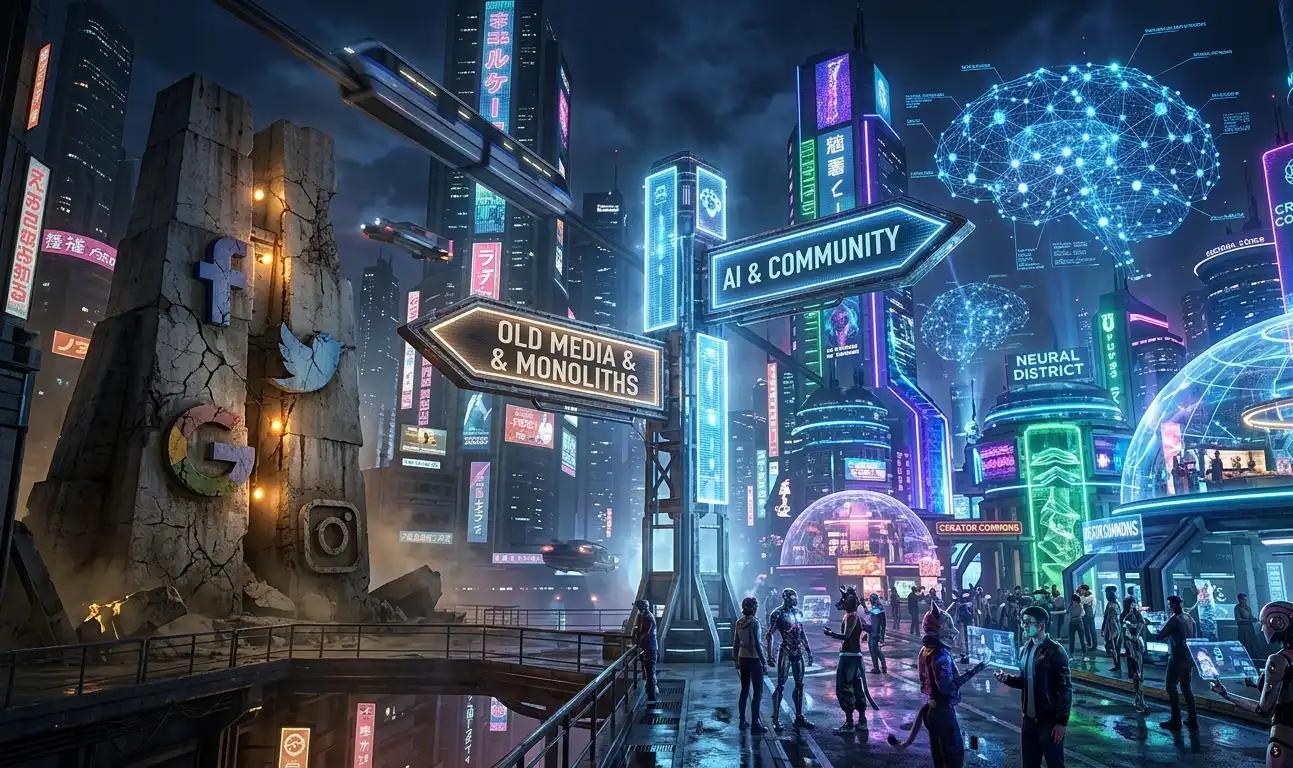
Executive Summary: The Tectonic Shift in Digital Behavior
For more than a decade, the architectural hierarchy of the internet felt permanent and unshakable. The daily digital routine of the average consumer was highly predictable and almost entirely centralized: we searched for factual information exclusively on Google, we connected with our family and friends on Facebook, we caught up on the day's events through legacy portals like Yahoo, and we shopped for second-hand goods on Craigslist or eBay. These massive platforms were the unquestioned gatekeepers of the World Wide Web.
However, a meticulous analysis of United States search interest data over the past five years reveals a fascinating, highly disruptive, and completely irreversible story. The foundational pillars of the old internet are cracking under the immense weight of changing user expectations. They are rapidly making way for a completely new era—one entirely dominated by generative artificial intelligence, hyper-niche micro-communities, and a relentless consumer demand for instant, ad-free, and authentic answers. We are currently witnessing the most significant digital migration since the transition from desktop computers to mobile smartphones.
The Rapid Decline of the Legacy Gatekeepers
To fully understand the future of the internet, we must first look at what users are actively leaving behind. The numbers surrounding legacy platforms speak volumes about the evolving psychological preferences of the modern digital consumer. According to recent five-year trend data, traditional social media networks and classic search engines are experiencing a severe, systemic downturn.
Search interest for Facebook has plummeted by a staggering 60%. This is not a mere statistical anomaly, a seasonal dip, or a temporary fluctuation; it represents tens of millions of users fundamentally changing how and where they choose to spend their precious screen time. Similarly, direct brand queries for Google itself have dropped by 30%. Traditional broadcast news outlets are not immune either, with CNN and Fox News down 30% and 20% respectively. Legacy internet portals like Yahoo are seeing a massive 40% decline, while their email service (Yahoo Mail) is down 30%. Even long-standing e-commerce and classified heavyweights like eBay (-50%) and Craigslist (-70%) are seeing their historical market dominance aggressively erode.
What exactly is driving this mass exodus from the platforms that literally built the modern web? The overarching cause is a phenomenon industry researchers call algorithmic fatigue. Modern consumers are increasingly exhausted by search engine results pages (SERPs) that prioritize heavily monetized, massively over-optimized content over direct, concise, and genuinely useful answers. When a user searches for a simple recipe and is forced to scroll through a 2,000-word, SEO-optimized life story just to find the ingredient list, user friction reaches a boiling point. Furthermore, users feel deeply alienated by social media feeds that have transformed from chronological updates about real-life friends into aggressive, personalized television networks pushing endless sponsored content and influencer advertisements. The fundamental trust in centralized, opaque algorithms is currently at an all-time low.
The Reddit Renaissance: Why Authenticity is the New SEO
If millions of users are actively abandoning traditional search engines and algorithmic social feeds, where is their attention going? The data points directly to decentralized, user-moderated, and text-heavy communities. Search interest for <strong>Reddit has surged by an incredible 90%</strong> over the last five years. In tandem, communication platforms built around real-time, niche communities, such as Discord, have seen a massive 120% increase in search volume.
This remarkable trend highlights a crucial evolution in user search intent. When a modern consumer is looking to buy a new laptop, figure out a bug in a complex piece of software, or get a genuine review of a local restaurant, they no longer intuitively trust the top three links on a traditional search engine. They know those top spots are often bought, paid for, or manipulated by massive affiliate marketing networks. Instead, they increasingly and intentionally append the word "Reddit" to the end of their search queries.
They are actively bypassing algorithmic curation to seek out the human element—the unvarnished, peer-reviewed, and brutally honest truths that traditional search engines actively suppress in favor of optimized publisher content.
Key Drivers Behind the Explosive Growth of Community Platforms:
- Unfiltered Authenticity and Trust: In an era of rampant sponsored content, undisclosed affiliate links, and AI-generated deepfakes, peer-to-peer recommendations and community-upvoted answers feel infinitely more reliable, authentic, and unbiased than branded corporate messaging.
- Hyper-Niche Expertise: Subreddits and specialized Discord servers offer incredibly focused, highly moderated communities for literally any imaginable hobby, profession, medical condition, or technical problem. This allows users to directly connect with true subject matter experts rather than reading generalized articles written by freelance copywriters.
- The Escape from Aggressive Monetization: Users are actively seeking a digital refuge from the heavily monetized, popup-saturated environments of legacy websites. They crave raw conversations, shared knowledge, and a sense of belonging, not endless commercial interruptions.
The Generative AI Disruption: The ChatGPT "Breakout"
While the massive return to community forums represents the human, sociological side of this digital migration, the technological side is being entirely driven by the advent of Generative Artificial Intelligence. The absolute most disruptive force in the 5-year data set is, without a doubt, AI. Search queries for "ChatGPT" are officially categorized as a "Breakout" trend, with related search variations like "chat gpt" exploding by an astronomical, paradigm-shifting 4,400%.
Generative AI models are uniquely positioned to finally solve the exact user-experience problems that traditional search engines created over the past decade. The old model of digital discovery involved entering a keyword, receiving ten blue links, opening multiple tabs, reading long articles, aggressively dodging banner ads, and mentally synthesizing all the fragmented information to find a single answer. Artificial intelligence completely eliminates this friction. Language models do the heavy lifting instantly.
These systems provide highly accurate, synthesized answers, write functional computer code in seconds, draft professional emails, summarize 100-page PDF documents, and explain incredibly complex scientific topics in simple, conversational terms. Interestingly, the data shows that basic internet utility remains king. Search terms like "calculator" (+5%) remain steady, and language translation tools are seeing a massive boom, with "traductor" (+70%) and "spanish to english" (+30%) showing exceptionally healthy growth. This indicates that users are leaning heavily into the internet as a direct utility tool to solve immediate cognitive problems, an area where conversational AI excels perfectly.
"We are actively witnessing the internet transition from a clunky, outdated era of 'information retrieval' to a streamlined, frictionless era of 'direct answers and authentic human experiences'. If a machine can give you the objective fact instantly, you only go to a forum to find out how a real human feels about it. Everything in between is becoming obsolete."
The Future of Web Discovery (2026 and Beyond)
The simultaneous, explosive boom of Reddit and ChatGPT against the dramatic backdrop of Google and Facebook's steady decline points to a highly bifurcated, split future for internet users, digital creators, and digital marketers. The internet is definitively dividing into two distinct lanes, and the "middle ground" of generic, SEO-stuffed blog posts is rapidly dying off.
- The Lane of Machine Efficiency (Objective Tasks): For factual, objective, and task-oriented queries (e.g., "how to write a python script," "summarize this historical event," "translate this legal document"), users will bypass traditional search entirely. They will rely almost exclusively on conversational AI tools to get instant, synthesized, and highly accurate answers without ever clicking a single external link.
- The Lane of Human Authenticity (Subjective Experiences): For subjective, emotional, and experience-based queries (e.g., "is this specific brand of running shoes actually comfortable for flat feet," "what is it really like to live in Seattle," "how to deal with postpartum anxiety"), users will flock to decentralized platforms like Reddit, Discord, and specialized forums to hear real stories, debate opinions, and build genuine human relationships that a machine cannot simulate.
As we navigate this exciting, yet turbulent new digital landscape, businesses, content creators, and marketing professionals must fundamentally adapt their long-term strategies. The focus can no longer be simply on ranking for a high-volume keyword through traditional, manipulative SEO tactics. Success in the new AI-driven internet era is entirely about providing genuine, irreplaceable value, participating actively and transparently in community conversations, and leveraging AI to work smarter. The web has permanently split into machine efficiency and human authenticity—and legacy platforms that remain stuck in the middle are paying the ultimate price.