The Battle for Attention: Why Traditional Education Lost
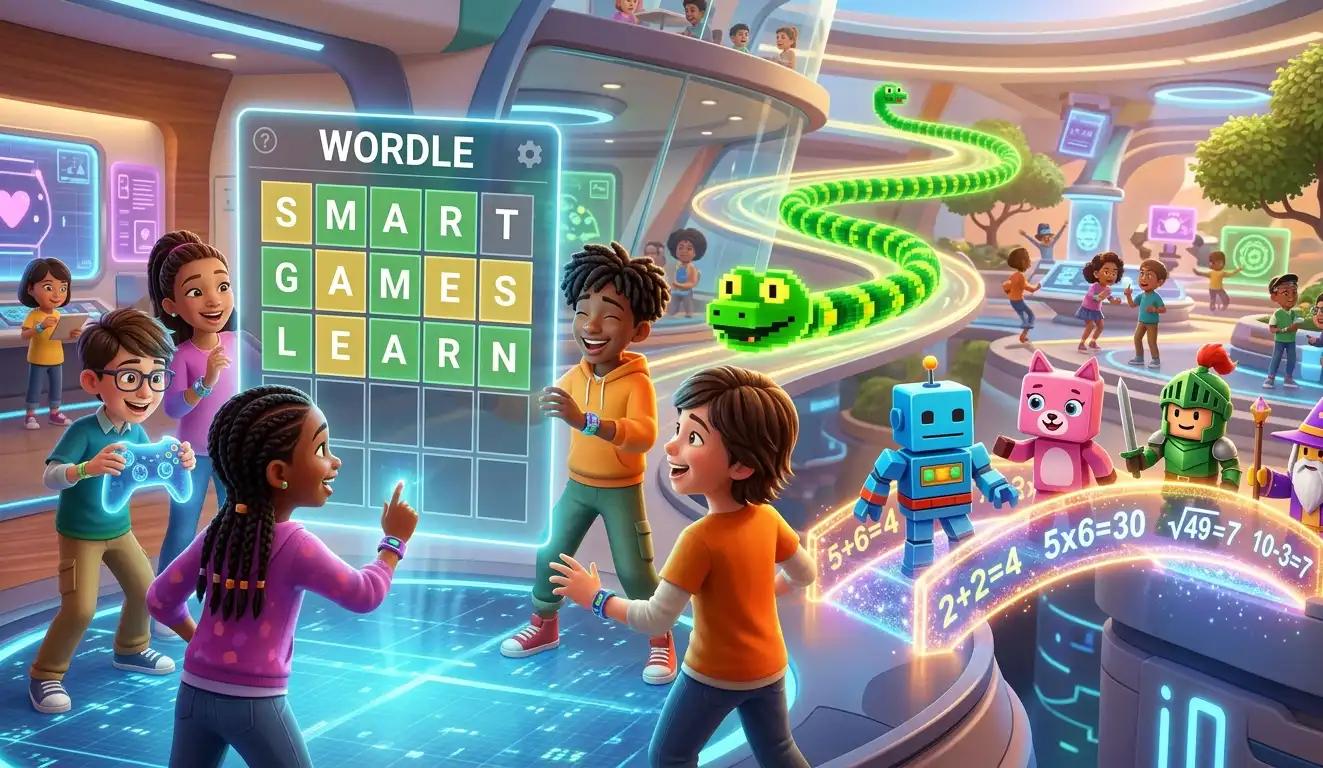
In the ruthless modern attention economy, human focus is the ultimate currency. For years, traditional educational systems and corporate training modules attempted to force engagement through obligation and authority. They failed. The human brain, constantly bombarded by the hyper-stimulating algorithms of social media, simply stopped responding to static text and passive lectures. The search data from the last five years provides incontrovertible proof of a massive paradigm shift. Blooket, a gamified learning platform, has seen its search interest detonate by an unimaginable 4,800%. Simultaneously, micro-games like Wordle achieved permanent "Breakout" status. The verdict in 2026 is absolute: if learning is not designed as a compelling, interactive game, it is entirely invisible to the modern mind.
This is the dawn of the "Dopamine Classroom." We are no longer discussing superficial gamification—adding a few digital badges to a boring PDF. We are discussing the profound integration of behavioral psychology, rapid feedback loops, and neurochemical rewards into the core architecture of knowledge transfer. EdTech has stopped trying to fight the gaming industry and has instead absorbed its most potent weapons.
"You cannot demand focus from a generation raised on instant gratification; you must engineer it. The most successful educators of 2026 are, fundamentally, game designers."
Deconstructing the 4,800% Surge: The Blooket Formula
To understand Blooket's 4,800% growth, one must look at how it differentiates itself from older platforms like Kahoot. While Kahoot relied purely on the stress of speed and competition, Blooket introduced sophisticated meta-game mechanics. Answering a math or history question correctly in Blooket does not just yield points; it yields currency. This currency is used to buy power-ups, sabotage opponents in real-time, or unlock rare, collectible avatars known as "Blooks."
This creates a multi-layered dopamine loop. The student is engaged not only by the academic challenge but by strategic resource management and social status building. The search interest for "Rare Blooket Hacks" or "How to get the Mystical Blook" highlights how deeply entrenched this digital economy has become in the psychology of students. Blooket succeeded because it recognized that academic achievement, when paired with digital ownership and peer competition, becomes a highly addictive pursuit.
Wordle and the Power of the Micro-Habit
While Blooket rules the competitive classroom, Wordle dominates individual cognitive habits. Achieving "Breakout" status, Wordle's brilliance lies in its enforced scarcity. You can only play it once a day. It takes less than five minutes. It offers an easily shareable, standardized social currency (the grid of colored squares). This simple mechanic revolutionized how we think about micro-learning in 2026.
Corporate training and language learning applications immediately cloned the Wordle formula. The data shows that users are highly resistant to 45-minute training seminars, but they will eagerly participate in a daily, 3-minute, highly constrained challenge that allows them to compare scores with their colleagues. Wordle proved that consistency beats intensity, and that cognitive friction, when properly balanced, is deeply satisfying.
Roblox: The True Educational Metaverse
While tech billionaires spent billions trying to force adults into sterile VR meeting rooms, a genuine educational metaverse was quietly being built by teenagers. Roblox has grown by 60%, evolving from a blocky game into a global educational infrastructure. In 2026, Roblox is not just a place to play; it is a place to engineer.
The 30% increase in search interest for Scratch (a visual programming language) is directly correlated to the Roblox phenomenon. Kids are highly motivated to learn complex logic, Lua scripting, and 3D modeling because the immediate reward is a playable game that their friends can experience. This is "Project-Based Learning" on steroids. Roblox provides an environment where physics, economics (managing Robux), and computer science are not abstract textbook concepts, but vital survival skills in a virtual world. It has created the most tech-literate generation in human history, bypassing traditional STEM curricula entirely.
The Rebound of Simplicity: Why "Google Snake" is Up 250%
One of the most fascinating data points is the 250% surge in searches for Google Snake. In an era dominated by hyper-realistic graphics and complex AI generation, why are users flocking to a game from 1997? The answer is cognitive overload. As our digital workflows become incredibly complex, the human brain requires periodic palate cleansers to avoid burnout.
Google Snake offers instant access to the "Flow State." There are no tutorials, no micro-transactions, and no ambiguous rules. It is a closed system of pure action and reaction. This teaches EdTech developers a crucial lesson: while meta-mechanics (like Blooket) are great for long-term retention, there is massive value in ultra-simplistic, frictionless experiences. Cognitive breaks are just as important as cognitive loads, and the modern internet user is actively searching for ways to briefly disconnect from the noise.
The Enterprise Shift: Gamifying the Global Workforce
The principles driving the 4,800% growth in school-level gamification have completely infiltrated the corporate sector. "Gamified Onboarding" and "Interactive Compliance" are major trends in enterprise HR. Companies discovered that replacing a multi-page PDF with an interactive scenario—where employees earn points for identifying security threats or resolving customer disputes—increases retention rates by over 70%. In 2026, professional advancement is often tracked via digital skill trees, peer leaderboards, and unlockable professional perks, directly mirroring the mechanics that hooked users on video games a decade prior.
Ethical Considerations: The Danger of the Dopamine Treadmill
We cannot discuss the triumph of gamification without addressing its dark side. The reliance on dopamine loops to motivate learning raises serious ethical questions. Are we conditioning a generation to only acquire knowledge if there is an immediate, flashy reward? If the extrinsic motivation (the digital points) is removed, does the intrinsic motivation (the love of learning) survive?
In 2026, leading cognitive scientists are working closely with EdTech platforms to ensure that gamification is used as a bridge, not a crutch. The goal is to use the game to pull the student over the initial wall of friction, and then gradually fade the extrinsic rewards as the student develops genuine mastery and competence. The platforms that can successfully navigate this balance—using dopamine to spark the fire, but relying on actual intellectual growth to sustain it—will dominate the next decade.
Conclusion: Playing to Win the Future
The search trends are definitive. The 4,800% explosion of Blooket, the cultural permanence of Wordle, and the metaverse dominance of Roblox prove that the architecture of human learning has been permanently altered. We have mapped the neurobiology of engagement and applied it to education. The line between a video game and a textbook no longer exists.
For developers, educators, and leaders, the mandate is clear. To capture attention in 2026, you must respect the psychological needs of the user. You must build systems that challenge, reward, and connect people. You must make learning the most compelling game in town. The dopamine classroom is fully operational, and the only way to fail is to refuse to play.